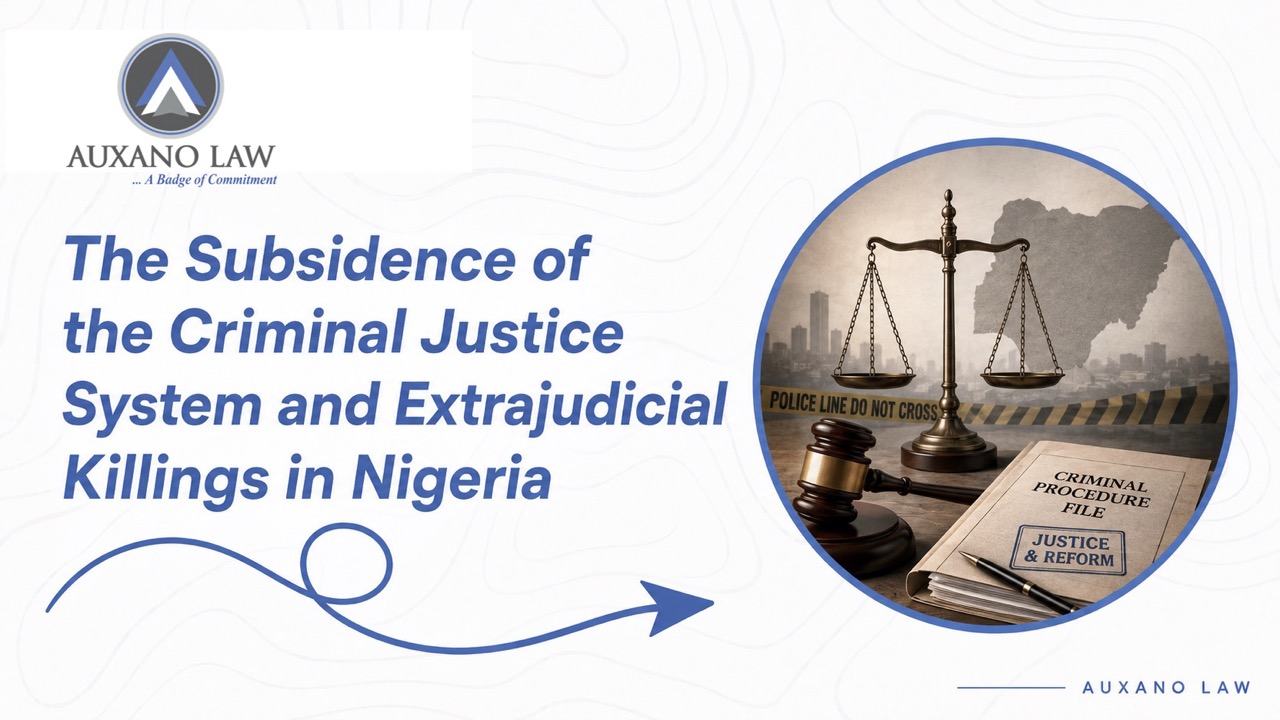
THE SUBSIDENCE OF THE CRIMINAL JUSTICE SYSTEM AND EXTRAJUDICIAL KILLINGS IN NIGERIA*
Bonnievolo Ecoma**
Abstract
In its struggle for existence, the Nigerian criminal justice system presents a counterintuitive paradox: the substantive aspects of its criminal justice embody normative prescriptions relating to equity, fairness and regard for the rights of suspects and defendants in the administration of justice, but in practice, unethical practices by components of the system have blurred the distinction between punishing the factually guilty and protecting the factually innocent. Relying on the doctrinal research method, this paper presents unique and profound insights into the perverse practice of extrajudicial killings in Nigeria and finds that the practice has been sustained by the criminal justice system. It argues that the subsidence of the system has enthroned a culture of impunity and rejuvenated the presumption of guilt which is now both systemic and societal. A combination of these has rendered the system incompatible with its statutory objectives, thus making the attainment of justice elusive. The paper concludes by arguing that the cure for the pathologies of the system lies in the adoption of proactive measures to reform the system and arrest its subsidence. It recommends holistic reforms which will reposition the system, stem the tide of extrajudicial killings, and save the system from imminent collapse.
KEYWORDS: Extrajudicial Killing, Human Rights, Criminal Justice System, Nigeria
- 1.00 INTRODUCTION
Gallons of juristic ink have flowed continuously on the baleful state of criminal justice systems in Africa and the need to transform them. One of the most dominant features of such systems which scholars readily trace to colonialism is the continued existence of inherited colonial legacies in spite of post-colonial reforms. In other words, the demise of colonial rule has not ended the metropolitan traditions in the criminal justice systems with regard to their structure, functions, norms and attitudes. The Nigerian criminal justice system is no different but this is only a fraction of the problem. Currently, the system is at the brink of collapse drawing from unethical practices which it developed and continues to exude as traits. Such systemic practices which are highly prejudicial and constitutionally offensive include impunity, contempt for the rule of law, and a general disregard for fundamental rights. With corruption, inept officials and a general systemic failure, the components of the system appear to function at cross-purposes, thus tilting the system further away from achieving its fundamental objectives and ultimately branding it as an assemblage of uncoordinated institutions,1 a criminal justice system,2 and a conveyor belt of injustice, from beginning to end.3 Consequently, the system in its subsidence erodes public confidence, fosters impunity, and lends credence to resort to self-help and the perversion of justice, all of which challenge its legitimacy and credibility. One of the profound effects of the subsidence of the system is the sinister practice of extrajudicial killings which has assumed new dimensions whilst eating deep into the fabric of the society. The practice which is facilitated and sustained by the criminal justice system has in recent times, witnessed the unrestrained participation of both law enforcement agencies and citizens in almost every part of the country and has blurred normative intentions to punish the factually guilty and protect the factually innocent. The result has been the execution of alleged criminals with no clear distinction or determination as to guilt or innocence. The widespread impunity which goes with the practice reflects the deep flaws of the system and the profound failure of the system to meet the justice demands of the society. This paper examines the systemic and societal practice of extrajudicial killing in Nigeria with a view to revealing the fundamental nexus between the subsidence of the system, the rejuvenated presumption of guilt, and extrajudicial killings.
- 2.00 DEFINITION OF TERMS
Taken from geology, the word “subsidence” refers to the gradual sinking of the earth’s surface in response to geologic or man-induced causes. Land subsidence is caused by natural and/or anthropogenic processes including subsurface fluid extraction, underground mining, drainage of organic soils, sediment compaction/load in coastal regions, and permafrost degradation. 4 It is a hazard which increases flood risk, causes damage to man-made structures and cultural heritages in low-lying regions, exacerbates sea level rise in coastal regions, and results in significant socio-economic distress.5 Subsidence also means the waning or lessening of something. As used in this paper, it means the gradual sinking or near collapse of the criminal justice system in Nigeria as a result of self-induced systemic practices.
The phrase “criminal justice” represents an amalgam of the words “criminal” and “justice”, thus presupposing literally, that justice should be meted out to a criminal. This brings to the fore the need to clarify both terms. In simple terms, a criminal is a person who has committed a crime. Justice, per the Justinian view, is the constant and perpetual wish to render to everyone his due. Being a tripartite process that admits of complementarity, it represents the utilisation of law to uphold rights and punish wrongs, and is said to mean justice for the complainant, justice to the accused, and justice for the State. Criminal justice may be defined either as a legal process or as an academic discipline. The former with which this paper is concerned, refers to the whole process of bringing a criminal to justice, from investigation, through arrest, charge, trial, conviction, and finally to sentence. As a system, it refers to the entire spectrum of institutions, rules and practices aimed at social control, by the prevention, detection, investigation, prosecution and punishment of crime.6
Extrajudicial killing is simply the killing of a person without legal authority. It is one which is intentional, impulsive, based on no prior legal authorisation, and which has not been subjected to judicial proceedings. Also termed extrajudicial execution, it refers to the deliberate killing of an individual by a State agent (or with his consent) without a previous judgment affording all judicial guarantees, such as a fair and unbiased procedure.7 Extrajudicial killings or executions are purely illegal executions carried out in the absence of a death sentence imposed by a Court of law after a fair and unbiased trial. With the involvement, support or acquiescence of law enforcement agents, such executions deny alleged criminals the opportunity of having their day in court, strip them of fundamental rights, and deprive them of the most fundamental right‒ the right to life without recourse to legally established procedures or processes. Being broad in meaning, extrajudicial killings or executions may also refer to executions carried out summarily, arbitrarily, in armed conflict, or in line with statutory exceptions. Although extrajudicial killings or executions are mostly carried out by law enforcement agents, it is noteworthy that such executions are also carried out by criminals, terrorists, armed groups, disgruntled citizens and so forth. In this paper, extrajudicial killing or execution refers to non-judicial killings or executions carried out by law enforcement agents and disgruntled citizens in Nigeria.
- 3.00 SUBSIDENCE, PRESUMPTION OF GUILT AND EXTRAJUDICIAL KILLINGS: NAVIGATING THE INTERSECTIONS
The potency of a criminal justice system is, in many ways, reinforced by the twin pillars of public trust and confidence. Like a social contract, reposing trust and confidence in a criminal justice system bespeaks the voluntary capitulation of the will of the citizenry and confers on the system, legitimacy. Accordingly, citizens rarely take laws into their hands; they submit their complaints and/or grievances to the system for resolution. This is on the basis of the perceived or actual assurance that the system is capable of handling complaints efficiently and effectively, and most importantly, that justice will be served. The benefits are manifold: it reengineers the criminal justice system to function properly and purposefully; crimes are regularly reported and crime rates may reduce significantly; there is maximum cooperation between the citizenry and the system; street justice is abandoned for statutory justice; the rule of law prevails; the presumption of innocence is respected and enforced; and so forth. One of the grave symptoms of an ailing criminal justice system is lack of public trust and confidence and this, most regrettably, is the Nigerian situation. In effect, what obtains in the system and in society is a subtle form of anarchy which, if left unchecked, will result in the total collapse of the system and full-blown anarchy.
Over the years, public trust and confidence in the criminal justice system in Nigeria seem to be declining. Whilst Professor Alemika8 asserts that the legitimacy and public trust in the agencies involved in a criminal justice system are determined by the extent to which they are perceived to be effective, fair, responsive and incorruptible, he notes that there is little confidence in the Nigerian criminal justice agencies. In presenting indices to substantiate his assertion, Prof. Alemika notes that in the national criminal survey for 2012, the respondents exhibited a general lack of trust in the Police and the Courts; only 7.7% of the respondents reported that they trusted the Police, while 41.2% said they had just a little trust in the Police. Comparative data for the Courts showed that 1.3% of the respondents trusted the Courts a lot; 10.1% said they somewhat trust the Courts and 42.6% had just a little trust in the judicial system. Further, 45.6% of the respondents said most or all Judges were corrupt compared to 63.0% who said all or most police officers were corrupt. He further states that there is a widespread perception of corrupt behaviours among law enforcement and regulatory agencies in the country which indicates limited confidence in the police and judicial agencies.
Beyond statistics, glaring evidence which points to the fact that there is lack of trust and confidence in the Nigerian criminal justice system can be found in such elements as resort to self-help, impunity, abuse of human rights, the perversion of justice, and so forth. All these and many more are symptomatic of the subsidence of the criminal justice system. In its subsidence, the system struggles to dispense justice in accordance with the rule of law and statutory prescriptions, and has, in effect, orchestrated a paradigm shift in many respects, from the presumption of innocence to the presumption of guilt, thus shifting the burden of proof in respect of criminal allegations to the criminal defendant. This is more pervasive in extrajudicial settings such as on the street with disgruntled Nigerians, in encounters with and in the custody of corrupt law enforcement agents, and so forth. In essence, what is statutorily prescribed remains mere rhetoric. This is worsened by the fact that in Nigeria unlike in some countries, the presumption of innocence is strictly a trial right and so is inapplicable to pre-trial situations.9 What has now taken firm root in many respects is the presumption of guilt which is both systemic and societal. Capturing the baleful state of the criminal justice system, learned Silk and luminary, Jibrin Okutepa, SAN10 states that there is near complete failure on the part of not only the Nigerian police, but the entire agencies involved in criminal justice administration in Nigeria. In his words,
“The police and other security agencies respect the provisions of the Nigerian Constitution relating to right to dignity of persons from being tortured and degrading treatment, presumption of innocence and right to remain silent and be in consultation with Lawyers or other persons of the choice of the suspect, in breach. In Nigeria, we operate accusatorial system of criminal justice. Accused or suspects are by law presumed innocent until their guilt is established. But Nigeria Police Force and other security agencies practice inquisitorial system in their interrogations and investigations. Criminal suspects are presumed guilty before investigations… They pronounce the suspects guilty before arraignment in court…”11
Kpae and Adishi note that many citizens who have lost confidence in the criminal justice system take laws into their hands by passing instant judgment on suspected criminal offenders without due process and in contravention of the fundamental rights of the accused.12 They note further that resort to mob justice has become the only way many people feel they can express their displeasure and dissatisfaction over a failing criminal justice system especially as the criminal justice system is defective in the processing of criminal offenders.
Notionally, the presumption of guilt is a principle which considers a suspect or defendant guilty until he is proven innocent. The implication is that the burden of proof which should ordinarily be on the State is rather fixed on the criminal defendant who is then required to present cogent and compelling evidence to effect an acquittal. It may prima facie seem safe to assume that the presumption of guilt is the antithesis of the presumption of innocence; such assumption is however not a clear-cut one. While opinions are divided on the matter, Professor Herbert Packer cautions that “it would be a mistake to think of the presumption of guilt as the opposite of the presumption of innocence that we are so used to thinking of as the polestar of the criminal process…”13 An analysis of the rationale for Prof. Packer’s stance reveals certain facts: (a) the presumption of guilt is discussed in respect of a formal criminal system which embodies a screening process for suspects; (b) the discussion of the concept straddles between disputations as to what is and what ought to be; and (c) the concept is, to some degree, viewed as an essential element of a model that corresponds in some regards, to the real-life operation of the criminal process.
Interestingly, Prof. Packer’s viewpoint is hinged on an idea between models; that screening processes for suspects exist which are operated by the police and prosecutors, and which are reliable indicators of probable guilt. Accordingly, once a suspect has been investigated and found to be probably guilty, all subsequent activity directed towards him will be based on the view that he is probably guilty.14 Although Prof. Packer states that the precise point at which this will occur varies from case to case, he posits that in any case, the presumption of guilt will begin to operate well before the suspect becomes a defendant. He opines further that the presumption of guilt is not a thing, nor is it even a rule of law in the usual sense; it simply exemplifies a complex of attitudes, a mood. The following sums up Prof. Packer’s position:
“The presumption of innocence is a direction to officials how they are to proceed, not a prediction of outcome. The presumption of guilt, however, is basically a prediction of outcome. The presumption of innocence is really a direction to the authorities to ignore the presumption of guilt in their treatment of the subject. It tells them, in effect, to close their eyes to what will frequently seem to be factual probabilities.”15
Certain points from Prof. Packer’s thesis are pertinent and thus central to this paper: (a) it speaks of the presumption of guilt as an attitude or mood: a prediction of an outcome or factual probability (probable guilt); (b) it recognises the fact that the attitude or mood is innate; and (c) the presumption of guilt is viewed as “one which begins to operate well before the suspect becomes a defendant.” These points are hereunder examined in relation to the operation of the presumption of guilt in the Nigerian criminal justice system and society.
For obvious reasons, the first and second points detailed above may be consolidated for analysis. The presumption of guilt in Nigeria takes its roots from the natural proclivity of humans to prima facie assume or conclude (without evidence) that a person against whom an allegation is made is in fact guilty as alleged. This inclination may be whittled down by several factors which traverse the social-cultural sphere. Although it may be impossible to obliterate such proclivity, trust and confidence in the criminal justice system inter alia serve as suppressants. Lack of trust and confidence in the system has the adverse effect of resort to self-help which in turn rejuvenates and sustains the natural tendency to make snap judgments. One profound result of snap judgments in the Nigerian milieu as a result of the rejuvenation of the presumption of guilt is extrajudicial killing. On the last point deduced from Prof. Packer’s thesis, the presumption of guilt in Nigeria rarely gives room for a suspect to become a defendant. Especially as it relates to extrajudicial killings, the alleged criminal is speedily executed without any reservation or recourse to institutions established for the purpose of factually determining guilt or innocence. Accordingly, the presumption of guilt detached from the institutional dimension advanced by Prof. Packer, lends no credence to the determination of the guilt of a suspect or further investigation to ascertain the culpability of a suspect. On the part of the citizenry and corrupt law enforcement agents, the presumption of guilt has no patience for the instrumentality of the law, neither has it regard for such constitutional guarantees as fair hearing, life, and freedom from torture, inhuman and degrading treatment. Indeed, the Nigerian criminal justice system has turned Blackstone’s ratio on its head, from “it is better that ten guilty persons escape than that one innocent suffer”, to it is better that all alleged criminals be dealt with summarily according to the laws of the jungle (whether they are innocent or not) than that one factually guilty criminal escape under the guise of the presumption of innocence.
Illegal and unethical practices in the criminal justice system have trickled down into the society and have led inter alia, to the untimely death of people who are not factually guilty, or who have not been so declared by a Court. The cumulative erosion of the presumption of innocence and ancillary rights, together with attendant lawlessness sustain the subsidence of the criminal justice system. The nexus between the subsidence of the system, the presumption of guilt, and extrajudicial killings becomes clear: unethical practices in the system including giving short shrift to the rule of law account for the subsidence of the system. That subsidence unearths the presumption of guilt which takes a very raw, callous and unrestrained dimension with multiplier effects. One of such effects is extrajudicial killing. The following section reveals the fine distinction between the legal idealism of presumption of innocence and the social reality of presumption of guilt primarily expressed through extrajudicial killings.
- 4.00 EXTRAJUDICIAL KILLINGS IN NIGERIA
The most sacred, fundamental and inalienable right of man which assumes a preeminent position in the scheme of rights is the right to life; without life, other rights would be without value. The right to life is thus a moral and legal principle which is based on the belief that individuals should be allowed to live and enjoy the full length of their lives until determined by natural causes or legal sanctions. This right is so fundamental that it has been enshrined in the Constitutions of countries as well as in regional and international instruments. For instance, Article 3 of the Universal Declaration of Human Rights provides that “everyone has the right to life…” Article 6(1) of the International Covenant on Civil and Political Rights provides that “every human being has the inherent right to life. This right shall be protected by law. No one shall be arbitrarily deprived of his life.” The African Charter on Human and Peoples’ Rights is not left out as it provides in Article 4 that “human beings are inviolable. Every human being shall be entitled to respect for his life and the integrity of his person. No one may be arbitrarily deprived of this right.”
While some instruments admit no derogation from the right to life, some admit exceptions. The Constitution of the Federal Republic of Nigeria 1999 (as amended), (otherwise referred to in this paper as the “Nigerian Constitution”) is an exemplar. Section 33(1) of the Nigerian Constitution provides that every person has a right to life, and no one shall be deprived intentionally of his life, save in execution of the sentence of a court in respect of a criminal offence of which he has been found guilty in Nigeria. Subsection (2) of the same Section further provides that a person shall not be regarded as having been deprived of his life in contravention of the Section, if he dies as a result of the use, to such extent and in such circumstances as are permitted by law, of such force as is reasonably necessary- (a) for the defence of any person from unlawful violence or for the defence of property; (b) in order to effect a lawful arrest or to prevent the escape of a person lawfully detained; or (c) for the purpose of suppressing a riot, insurrection or mutiny. The right to life is therefore a qualified right in Nigeria. That notwithstanding, the Constitution has clearly outlined situations under which the deprivation of life would be legally permissible. This may be termed “State-sanctioned murder”. This right nonetheless is so sacred that the State guards it jealously. Accordingly, where a deprivation of same occurs outside the ambit of the law, the State must purge itself. The law does not recognise or lend credence to extrajudicial killings.
The traditional denotation of extrajudicial killing is one which is carried out by State authorities but in Nigeria, the phrase also admits of mob attacks by disgruntled elements. It might be a herculean task to properly trace the evolution of extrajudicial killings in Nigeria but what is certain is that there was an upsurge of whatever fragment existed during military rule. Such fragments which increased during the different phases of military rule in Nigeria have evolved into full scale impunity in contemporary times. Condemning the practice, Egbewole and Onuora-Oguno16 stated thus:
“Currently in Nigeria, there is an increase in the spate of killings which neither meets the constitutional threshold of basis on which the sacrosanct right to life can be breached. In the same vein, countless and unaccountable killings abound, carried out by both non-conventional and conventional outfits which are neither judicially approved nor constitutional but seem to receive executive approval.”
Extrajudicial killing represents to a large extent, the new justice to the civilian population. The first State-orchestrated extrajudicial killing which received judicial condemnation was that of Nasiru Bello who was executed by the Oyo State Government while his appeal against his conviction for armed robbery was pending. The Supreme Court per Aniagolu, J.S.C. in Aliu Bello v. Attorney-General of Oyo State17 gave vent to its grave disgust thus:
“This is the first case in this country of which I am aware in which a legitimate Government of this country– past or present; colonial or indigenous– hastily and illegally snuffed off the life of an appellant whose appeal had vested and was in being, with no order of Court upon the appeal, and with a reckless disregard for life and liberty of the subject and the principles of the rule of law. The brutal incident has bespattered the face of the Oyo State Government with the paint-brush of shame.”
Extrajudicial killings as obtainable in Nigeria can be categorised into two: extrajudicial killings by law enforcement agents, and mob justice. These categories are hereunder examined.
4.1 Extrajudicial Killings by Law Enforcement Agents
The bulk of extrajudicial killings by law enforcement agents in Nigeria are carried out by the Police. Extrajudicial killings by the Police have rather been termed, and so aptly termed, “extrajudicial executions.” This is reflective (albeit in a subtle manner) of the nature and extent of the killing-spree embarked upon by trigger-happy police officers, which is usually done with reckless abandon and impunity. It is further reflective of the inordinate and unlawful use of firearms by the Police against suspects and even innocent civilians. Extrajudicial killings/executions by the police usually occur during police operations (at certain locations, checkpoints and on the streets), and in police custody.
The egregious use of firearms by police officers to wreak havoc and the impunity thereof are exacerbated by statutory provisions which justify to some extent, extrajudicial killings. A cursory look at Section 33 of the Nigerian Constitution reveals that although the Section guarantees the right to life, it allows for certain exceptions for the deprivation of life. Among these exceptions are two which readily apply to law enforcement agents, and which are so often abused by the police to perpetrate, justify, and conceal extrajudicial killings. They are the use of force: (a) to effect lawful arrest or to prevent the escape of a person lawfully detained, and (b) for the purpose of suppressing a riot, insurrection or mutiny. The recklessness and impunity are further facilitated by the Police Force Order 237 (Rules for Guidance in the Use of Force and Firearms by the Police).18 While Section 2 of the said Order enjoins police officers to guard against the slightest misuse of firearms and to exercise the utmost forbearance humanly possible and that prudence can dictate, Section 3(d) and (e) permit officers to shoot suspects and detainees who attempt to escape from custody or avoid arrest. Even worse is the provision contained in Section 6 of the said Order which directs police officers in riot situations to shoot at the knees of the rioters, and that “any ringleaders in the forefront of the mob should be singled out and fired on.” Amnesty International19 notes that the Police Force Order 237 has resulted in numerous unlawful killings and facilitated extrajudicial executions, while police officers go largely unpunished, using it as a justification as well as cover-up for the use of lethal force.
Police operations have overtime been used as an excuse to carry out extrajudicial executions. Such executions which are carried out without recourse to the rights of suspects, the rule of law and judicial proceedings, are so often justified under the provisions of the Law referred to above. The trend has been to label the victims (which oftentimes include innocent bystanders) as “armed robbers” and claim that an “accidental discharge” occurred. Such labels seem to provide justification in addition to the above reflected provisions, for the despicable practice of executing unarmed civilians who pose no immediate threat. Engagement in official duty and operations now serves as a license to kill with impunity. At checkpoints, commercial drivers are usually the target as they are compelled to pay bribes. When there is non-compliance by the driver or a disagreement ensues as to the amount, the next step would be to shoot the unarmed driver and, in the process, innocent bystanders may be hit by stray bullets. In this regard, Amnesty International20 details the case of Aneke Okorie, an Okada rider (a commercial motorcyclist) who failed to pay a bribe to the police at a checkpoint in Emene, Enugu State on 15th May 2009. He was shot dead. An eyewitness account revealed that the police officer who shot the deceased placed his gun on the deceased so as to give the impression that he was an armed robber. Amnesty International notes further that as a way of covering up their sinister acts, the police often place weapons on the bodies of extrajudicially executed persons and thereafter claim that they were attacked by an armed robber who was killed in a shoot-out or in the process of trying to escape. Regrettably as Amnesty notes again, such sinister acts and cover-ups which are rarely investigated enthrone a culture of impunity which sustains further executions. In this regard, the United Nations Special Rapporteur on Extrajudicial, Summary or Arbitrary Executions21 notes the following:
“Police put forth various pretexts to justify extrajudicial executions. When a victim is killed in custody, an attempted escape may be cited. When the victim is killed before being taken into custody, his status as an armed robber may be cited. While armed robbery plagues much of Nigeria, the label of “armed robber” is very often used to justify the jailing or extrajudicial execution of innocent individuals who have come to the attention of the police for reasons ranging from a refusal to pay a bribe to insulting or inconveniencing the police. Extrajudicial executions are also facilitated by the impunity the police force enjoys.”
The Report further notes that the false labelling of people as armed robbers, the shooting, the fraudulent placement of weapons, the extortion of the families of victims, the contempt for post mortem procedures, falsified death certificates, and the flight of an accused police officer are all too familiar occurrences. It details instances of the most brutal extrajudicial executions by the police, some of which are the “Apo 6”, the “Enugu 6”, and the execution of Lawan Rafa’i Rogo. The last instance is representative of an extrajudicial execution which saw the participation of the Police and the Nigerian Army. The 2008 Presidential Committee in Nigeria noted that the Nigerian Police treat the number of “armed robbers” injured or killed by them as indicators of success. According to the Committee, the police refrain from using statistics to evaluate their performance; they rather resort to the parade and media trial of suspects, as well as the parade of corpses of extrajudicially executed persons labelled by them as “armed robbers”. Okonkwo22 opines that it is better that a suspected offender should escape arrest than that he should be executed by the police without trial. Prof. Akinseye-George23 notes in this regard that public perception against police brutality is so high that the popular view must be that police power to kill should be restricted to the killing of armed criminals in circumstances where the lives of the policemen are in danger and less extreme measures are not available to avert the danger.
Executions also occur while suspects and other innocent individuals are in police custody and this seems to be the norm. There is the flagrant disregard for human rights. For detainees, the first step in the process is to deny them the right of access to a lawyer. Some are detained for weeks or months without being charged to court. While in custody, they are tortured, subjected to several forms of inhuman and degrading treatment, and for those who are suspected armed robbers, they are usually shot in the leg or killed outrightly. The police have often justified this brutality towards armed robbers and suspected armed robbers by stating that they kill them “…because of the supposed failure on the part of the justice system to ‘cage’ armed robbers.”24 Noting the prevalence of enforced disappearances, Amnesty International25 states that “extrajudicial executions, other unlawful killings and enforced disappearances in Nigeria are not random. In a country where bribes guarantee safety, those who cannot afford to pay are at risk of being shot or tortured to death by the police. The families of the victims often cannot afford to seek justice or redress, because they cannot pay for a lawyer or the court fees.” It also notes that in many instances, the families of victims are unable to retrieve the bodies and in some, the bodies are buried in mass graves without prior notice to or consent of the families of the deceased persons.
The reckless nature of police officers has been condemned and curtailed by the Courts but this is only in cases which come before the courts and which of course, constitute far less than a fragment of such instances of recklessness by the police. The dicta in the following cases further reveal the extent of extrajudicial executions by the police. In Olaiya v. The State,26 the Court held thus:
“To embark on official operation is not a license to kill. It is imperative for security men who bear arms to exercise maximum restraint in the use of the weapons assigned to them in order not to endanger the lives of the citizens that they are employed to protect. In the instant case, the appellant and his co-convict took the decision to open fire on the crowd on their own volition and were therefore not covered by any rules of engagement. The fact that they were on official duty did not exonerate them from culpability.”
In Oyakhire v. The State,27 the Supreme Court per Tabai, J.S.C. held thus:
“This case represents the height of man’s inhumanity to man. The appellant and his co-accused police constables employed by the nation to protect the lives and properties of its citizenry embarked on this unlawful mission in their brazen brutality, terminated the lives of these five innocent and defenceless victims, with unimaginable damages to their beloved ones and families back at their various homes. The case demonstrates the regrettable reality that the numerous police check points along our highways only give the citizenry a false sense of security.”
In Adekunle v. The State,28 the Supreme Court per Ogbuagu, J.S.C. held thus:
“Let me observe here, that it is becoming very notorious and most disturbing these days when policemen, use guns purchased for them with public money and meant for the protection of the citizenry are freely used to mow down innocent citizens of this country with reckless and careless abandon and in each case or every event, the aggressive policeman is heard to say and rely on “accidental discharge”. Enough, I think is enough. Unless the courts put down their feet so to speak and make it abundantly clear to our policemen in this country, that never again will such plea or defence be available to any of them accused of murder or acceptable by the courts, then of course, Nigerians will continuously be sprayed with bullets from the police who will hide on the plea “he was killed by stray bullet” or by “accidental discharge”. I suppose that when a gun is properly locked, stray bullets and accidental discharge syndrome will not occur. Invariably, accidental discharge always occur when some of the drivers are unwilling and refuse to pay the N20.00 (Twenty Naira) or such money being extorted by the police at every check point (and there are so many on our roads, separated by very short distances). When such drivers refuse to stop, oh yes, they must be carrying contraband goods or some imagined incriminating stuff. This state of affairs is of common knowledge and it is a notorious fact on our Nigeria roads.”
Finally, in Agbo v. The State,29 the Supreme Court per Mukhtar, J.S.C. held as follows:
“Indeed, the evidence before the trial court was quite overwhelming and points to the guilt of the appellant. Situations like this whereby policemen rashly bring out their guns (albeit to merely threaten or frighten citizens) is rapidly becoming rampant. They are meant to use the guns to safeguard the lives of the citizenry they are paid to protect, but the reverse is the case. A policeman will not hesitate to pull the trigger of his gun at the slightest provocation, and would indeed do that with relish and reckless abandon, not caring whether the consequence of his act will be fatal. The incident in the instant case is a locus classicus. A law enforcement agent who is supposed to bring sanity and order on the road brings out his gun and fires it just because a driver obstructs his right of passage… In fact the mere fact that he deemed it necessary to bring out a gun from wherever he had kept it is enough act of recklessness, even if no shot was fired, and in this case there is ample evidence that it was. I believe such rash act must be stopped to prevent innocent lives from being wasted.”
The United Nations Special Rapporteur on Extrajudicial, Summary or Arbitrary Executions30 notes that the single greatest impediment to bringing police officers to justice for their crimes is the Nigeria Police Force itself; evidence indicates that it systematically blocks or hampers investigations and allows suspects to flee. It is noteworthy that extrajudicial executions are rarely investigated or documented as such they are largely unaccounted for. This enhances the culture of impunity as investigations are only carried out when there is public outrage. Where such investigations are even carried out, they suffer from inefficiency, partiality, lack of accountability and inordinate delays. Stakeholders note that the absurd and made-up rationalisations of killings by the police do not only constitute major barriers to accountability, they provide a needed and well-suited cover for impunity. In many cases, police officers who have carried out extrajudicial executions are transferred to other States or sent on training so as to forestall investigation and prosecution.31 Regrettably, such ruthless officers who are transferred to other States or locations continue to kill with reckless abandon.
Notable examples of extrajudicial executions by police officers in Nigeria abound. One which is reflective of the rippling effect of extrajudicial executions is the killing of the leader of Boko Haram, Mohammed Yusuf, whose extrajudicial execution in 2009 is believed to have lit the fire which snowballed into uncontrollable insurgency. Reports show that although the police claimed to have shot and killed Yusuf when he attempted to escape from custody, he died still wearing handcuffs. The New York-based Human Rights Watch described Yusuf’s death as an extrajudicial killing and further described it as “a shocking example of the brazen contempt by the Nigerian police for the rule of law.”32 Other examples are the killing of Kolade Johnson in Lagos, as well as the killing of the Remo Stars footballer, Tiyamiyu Kazeem and so forth.
It is noteworthy that extrajudicial executions are also carried out by other agencies. A subdivision of the Police, the Special Anti-Robbery Squad (“SARS”) for instance, is renowned for extrajudicial executions in outrageous proportions. In fact, the acts documented above are primarily carried out by SARS, being the most brutal subdivision of the police. It may be described as a band of ruthless men clad in black. An apt description is “a police unit notorious for extrajudicial killings, extortion, human rights violations, profiling of young men and disproportionate use of force.”33 As Amnesty International34 notes, “SARS is responsible for widespread torture and other cruel, inhuman or degrading treatment or punishment of detainees in their custody. Detainees, both men and women, are subjected to various methods of torture and ill-treatment in order to extract information and ‘confessions’. Such methods include severe beating, hanging, starvation, shooting in the legs, mock executions, and threats of execution.” As well, SARS officials involved in the commission of such sinister acts enjoy unbridled license to further perpetrate their acts as a result of the culture of impunity. In recent times, they are known for committing heinous crimes,35 investigating civil cases, and torturing detainees involved in non-criminal disputes in addition to extrajudicial executions and unlawful detentions.
The savage and inhuman brutality by the police violates the rights of citizens, suspects and even defendants. There appears to be no scintilla of respect for human rights or even the rights of suspects and defendants as enshrined in the Nigerian Constitution and other statutes. In some cases, as noted above, most suspects are summarily executed and so do not have the ‘privilege’ of being charged to court so as to defend themselves, or be clad with the presumption of innocence. In this regard, constitutional provisions as to the rights of suspects and defendants are mere rhetoric and are totally disregarded. Punishment for such heinous acts even within the police is rarely meted out and this reveals high-level complicity across the cadres of the police. What is then clear is that once a person is arrested or becomes a suspect, he is presumed guilty and thus his life and freedom hang in a balance as the opportunity to defend himself or prove his innocence is often denied. The police seem to have the unbridled right to kill at will without prior inquiry as to the guilt or innocence of a suspect. This gives room for impunity in the society as well instances where innocent persons could be easily framed by foes and summarily executed by licensed killers who ironically, are employed to protect lives and properties, and are paid by those they kill.
4.2 Mob Justice
Mob justice, also known as mob attack, and popularly referred to as ‘jungle justice’, is an extrajudicial and public execution in which an alleged criminal is tortured and summarily executed by a crowd. The mob represents the Judge, Jury and Executioner, and the essence of the trial by ordeal is not to determine the guilt or innocence of the alleged criminal, but to mete out justice based on the presumption of guilt. Such a presumption in this wise, is irrebuttable. It is a mockery of justice and so the word “justice” therein is but a figment. It consists in the deprivation of all rights statutorily available to an alleged criminal or suspect, including the right to life. Here, a suspect is tortured inordinately and subjected to treatments which are infra dig. This malevolent act seems to have gained recognition and acceptance in some parts of the country and appears to be a form of entertainment for some as pictures are usually taken and videos recorded.
Scholars note that in Nigeria, the history of mob justice or howsoever called, is traceable to two central factors, to wit: (a) public executions by the military during military rule, and (b) lack of trust and confidence in the criminal justice system. As regards the first factor, history is replete with instances where suspected and convicted armed robbers were publicly executed by the military through firing squad. The first recorded public execution took place in 1971 at the Bar Beach in Lagos and saw the execution of three persons. Thousands of Nigerians rushed to the scene to catch a glimpse of the execution. In August 1994, 38 prisoners in Enugu were executed by firing squad before a large crowd. On 22nd July 1995, 43 convicted armed robbers were executed before a crowd of about 1,000 people at a Lagos prison. It is plausible that the essence of such startling displays was to serve as deterrence to potential armed robbers and criminals but evidently, the purpose was not achieved. While such executions are no longer as public and popular as they were formerly, the horrid experiences and gory sights have been deeply ingrained in the memory of many Nigerians.
On the second factor, while extrajudicial executions in contemporary times may seem to be the exclusive preserve of law enforcement agents in Nigeria, this sinister role is also played by citizens of Nigeria (vigilante groups inclusive), the ones so properly called the ‘ordinary people on the street’. This public outrage is not unconnected with extrajudicial executions carried out by the police, other law enforcement agents, as well as the military. As well and most directly, it is the result of the diminution of public confidence in the police and in the criminal justice system as a whole. While it may seem that the police execute almost anyone accused of being an armed robber or a criminal without exception, there is another side to the tale. With corruption in the Police and some other actors in the criminal justice system, those who can pay imposed bribes are let off the hook, while those who cannot afford to pay are dealt with in any manner deemed fit. In some instances, deadly criminals who terrorise neighbourhoods and communities are arrested by civilians and handed over to the police, or are arrested by the police, and before long, they are set free without being charged to court even when there is staggering evidence. In other cases, due to delays in the processing and prosecution of criminals, citizens lose interest and confidence in the system and thus prefer to resort to other means which will “facilitate justice”. The result has been a wide-range resort to self-help remedies which are brutal and inhumane.
Another factor is the insensitivity of the police to the plight of citizens. Where life-threatening situations require urgent attention by the police, they are rarely found. It is also a fact that informants who avail the police with details of notorious criminals and their hideouts are sold out by the police, hunted down by the criminals, and slaughtered. A culmination of all these and much more account for the resort to self-help remedies by citizens as the common belief is that there is no justice in the criminal justice system. To David Adeleke,36 jungle justice is a symptom of many diseases: a flaccid justice system, a lack of trust in the government, disregard for the rule of law and human rights, and the chronic anger of the people towards an exploitative system. Kpae and Adishi37 note as follows:
“…since the police institution is plagued with corruption, many notorious criminals and repeat offenders have avoided jail terms by maneuvering their way by either paying little tokens at police checkpoints or simply bribe their way out of police detentions through posting of bail sum. As a result, many members of the public who have see [sic: seen] violent criminals working [sic: walking] free on the street after they have been arrested by the police have lost confidence in the justice system, and resort to dealing summarily with suspected criminals rather than handing them over to the police.”
The authors note further that the prevalence of instant justice as a form of punishment for suspects seems to have also increased in Nigeria due to the abuse of the justice system by some well placed individuals. They state as well that there is flagrant disregard for the rule of law by some influential persons in society, thereby making citizens to use self-help to inflict capital punishment on suspected criminals without recourse to the law courts. Condemning mob justice, Joseph Otteh 38 states that jungle justice is a metaphor for the failure of justice, the failure of society to apply uniform and equal standards and processes to everyone, and the failure of the society to protect its people from the whims of base and irrational human instincts and impulses. He captures the problem in the following words:
“A society that allows a few people to take laws into their own hands, and sometimes take human life under that influence of that power, is a broken, lawless state. The entire concept of “State”, “government” and “Rule of Law” is lost where people are allowed to act, or not prevented from acting as though society were, as Hobbes said, in a state of nature, unregulated, unbridled, or life was “brutish, nasty and short.” When people take laws into their own hands in a society, they basically express the idea that state institutions of law and order are dysfunctional and lack trust or confidence. If people trusted those institutions, it is a lot easier to engage those institutions when crimes occur. … Our Police Force is broken, and has been so for as long as I can remember. Our judiciary too, is a largely inefficiently administered institution, and the idea of being stuck in courts once cases get in there they foster a loss of confidence in courts and a lot of people are not prepared to “let the law run its loss” in our law courts.”
Joseph Otteh notes that our criminal justice system is weak, disoriented, and unreliable; “…the criminal justice system is slack; there is nobody to hold anybody accountable for performance…”
A plethora of examples abound as to mob attacks which have resulted in the death of several Nigerians but one which remains fresh in the minds of Nigerians is the Aluu incident, usually tagged “Aluu 4” in which four students of the University of Port Harcourt were lynched on 5th October 2012 after they were accused of attempting to steal laptops and phones in Aluu community, Rivers State. The four young men were accused by a debtor who raised a false alarm when confronted in the early hours of the day to repay a debt owed, and claimed they were thieves. The vigilante group in the community had the impression that the students were the usual criminals who terrorised the community and thereupon, without any investigation as to the veracity of the claim, executed the students summarily after torturing them. A High Court sitting in Port Harcourt in 2017 however exonerated the murdered students and convicted three persons implicated in their murder.
Mob justice or howsoever called represents the height of discontentment among the citizenry. It is barbaric and draconian, and is reflective of the state of the criminal justice system in the country, and the insensitivity of same to the plight of the citizens. When citizens are dissatisfied with the state of the criminal justice system or the performance thereof, they prefer to deal with criminals and suspected criminals on their own terms without referral or recourse to established institutions or laws. The victims are therefore dealt with according to the laws of the jungle and so rights which should ordinarily accrue to them are denied. The situation is so critical that it occurs in almost every State in the federation. While in some cases the police are only informed when the deed has been done, and in others they successfully intervene before the victim is killed, in some other cases, policemen and other security agents stand aloof and watch how citizens who have not passed through the crucible of a proper trial are murdered by their fellow citizens. The Aluu 4 incident is a case in point as a police officer was found to be criminally negligent. In this regard, Prof. Egbewole and Onuoro-Oguno39 assert that policemen have stood aloof as ‘innocent criminals’ go ablaze and simply looked away with no feeling of having the constitutional responsibilities of protecting citizens while maintaining law and order. They note further that the act of extrajudicial killing is nowhere near justice but is rather a clear act of impunity and disrespect for the laws of the land. While it may be plausible that some of those summarily executed are factually guilty, one can certainly not rule out the possibility of a mistaken identity and the fact that thousands of innocent individuals have been erroneously killed.
- 5.00 CONCLUSION
At best, the Nigerian situation can properly be described as one which is steadily gravitating towards the Hobbesian state of nature. With reckless abandon, law enforcement agencies, the military and the citizenry descend on individuals who have allegedly committed offences and, without recourse to the criminal justice process or rights which accrue, they are slaughtered in the most barbaric way. What is more, only a few of the culprits are prosecuted and convicted of such offences which constitute murder. Accordingly, murderous lynching is the order of the day especially as in some instances, the police and other law enforcement agents are indifferent to criminal complaints and in others, they stand aloof and witness the murder of individuals who ought to be presumed innocent until the contrary is proved. Extrajudicial executions make nonsense of constitutional guarantees in respect of the rights of suspects and defendants, and of fundamental rights as a whole. This paper finds an inextricable relationship between the subsidence of the criminal justice system, the presumption of guilt, and extrajudicial killings in Nigeria. In addition, it finds that there is widespread unrestrained participation in the unlawful execution of individuals by law enforcement agents and ordinary citizens, and this seems to be the new justice for suspects and defendants.
The scourge of extrajudicial killings in Nigeria is facilitated by the subsidence of the criminal justice system which gives short shrift to the rule of law, and which has given impetus to the presumption of guilt. The presumption readily applies or fits into the spectrum of extrajudicial killings by disgruntled Nigerians; it is the determining factor, while for law enforcement agents, there is the admixture of corruption, impunity and a dose of the presumption of guilt. These are sustained by impunity across board which is also one of the end products of the subsidence of the system. The inequities and unethical practices in the system have, without a shadow of doubt, made access to justice and the attainment of same, elusive. This has resulted in despondency, pessimism and social disequilibrium which tilt the criminal justice system even further away from securing the rights of suspects and defendants, and from the society in general. Regrettably, the system now serves as an alienating and dehumanising system for those who come in contact with it. In the circumstance, what is therefore required to address the calamitous situation is the adoption of proactive and deliberate measures targeted at reforming the system and arresting its subsidence. Based on the critical issues raised in this paper, the following recommendations are made:
- There is an urgent need to declare a state of emergency on the criminal justice system in Nigeria. This is evidently the first step to take in order to salvage the system from imminent collapse. In addition, the criminal justice system must be repaired and strengthened to deliver justice to the populace. This requires the development of practices, processes and ethical standards which are responsive to the needs of the citizenry, and which show utter respect for their rights. Justice, equality, respect for the rule of law and accountability should become the new default setting of the criminal justice system. As well, the possibility of expanding the scope of the presumption of innocence to cover the pre-trial stage of investigation should be explored.
- The practice of human rights-based law enforcement can never be over-emphasised. When law enforcement agents respect and defend human rights, public trust and confidence will be reposed in them and this will foster cooperation. Inevitably, such a culture of respect for and defence of human rights will trickle down into the society. Human rights-based law enforcement implies comprehensive systematic and institutional compliance with national and international human rights standards and practices in the conduct of law enforcement functions which include equal protection, respect and compassionate treatment for those who come in contact with the system, the use of force only when necessary, arresting people on legal, reasonable and justifiable grounds, respecting, protecting and upholding the rights of suspects and defendants, institutional discipline, and so forth.
- Law enforcement agencies and the agents therein must be held responsible for malfeasances such as trumped-up charges, the unlawful incarceration of innocent persons, the destruction or withholding of exculpatory evidence, the fabrication of inculpatory evidence, obtaining and using coerced confessions, extrajudicial killings, media trials, and so forth. This must equally extend to prosecutors who condone such acts in a bid to secure more criminal convictions. Prosecutorial integrity must therefore be emphasised and enhanced. As a cautionary measure, a policy of liability for such misconducts should be put in place so as to ensure that those who wilfully incarcerate and in some cases, orchestrate the execution of factually innocent persons are dealt with according to law.
- Obnoxious regulations and statutory provisions like the Police Force Order 237 which serve as unbridled license for the excessive use of force and of firearms against innocent individuals even in situations which do not require such use of force should be expunged. Additionally, the high incidence and support for extrajudicial killings must be brought to a halt if life is to have any meaning in Nigeria. As a direct consequence of extrajudicial killings, violent crimes and violence generally thrive in the Nigerian society and a culture of impunity has been engendered. All parties involved in extrajudicial killings must be fully prosecuted and made to face the consequences of their actions.
- The National Orientation Agency, the Legal Aid Council and other stakeholders have a duty to carry out regular sensitisation of Nigerians on their rights and remedies in the event of an infringement. Also, extrajudicial killings should be censured and penal laws expressly dealing with same should be enacted. As well, interventions by the Legal Aid Council and other agencies in respect of unlawful detentions and executions will in no small measure aid in checkmating the excesses of law enforcement agents.
The above recommendations are made in an effort to save the system from total collapse, bring back justice into the system, restore the presumption of innocence, forestall the circumscription of rights of suspects and defendants, restore public confidence in the system, and have in place an efficient, effective, responsive, transparent, accountable, humane, and improved criminal justice system. While none of the measures advanced above may solely fix our criminal “injustice” system, approaching reforms systematically will offer a better chance at bringing to a halt, the grave injustices perpetrated in the system.